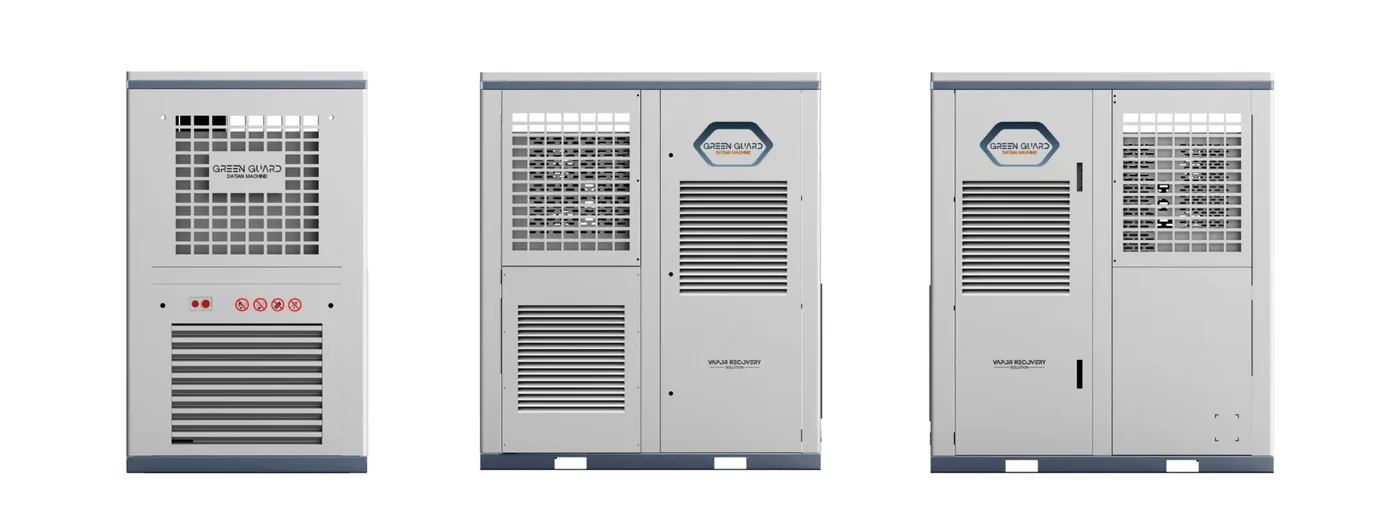
In many promotional materials, you see a bucket full of condensed liquid from a VRU, with the gas station owner smiling happily.
Mas você já parou para perguntar:
Este óleo condensado visível é realmente o “óleo economizado” para o seu posto?
Vejamos dados reais da nossa Green Guard VRU em operação em um posto de combustível.
Isto é de um posto na China equipado com Green Guard.
Verifique os dois registros operacionais marcados em vermelho.
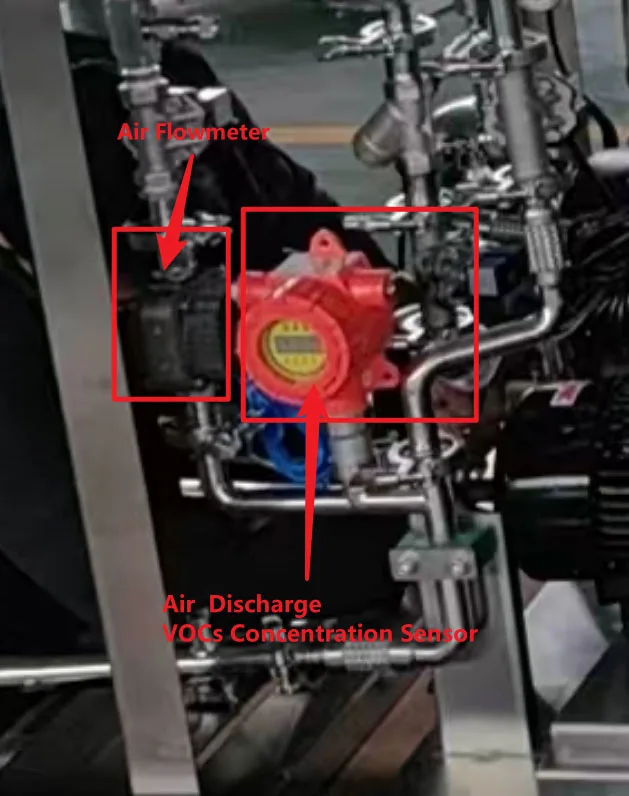
- When the unit runs at intervals within 2 hours, Green Guard maintains exhaust emission concentrations below 1 g/m³ (displayed as 0g due to system rounding, meaning <1 g/m³).
- On September 7, the unit ran every hour during the daytime. However, after 17:47, as nighttime temperatures dropped, tank pressure did not reach the 0.35 mbar startup threshold until 02:19 the next day—a gap of about 7 hours.
When it restarted, the vapor concentration inside the tank had risen significantly, and the emission reading showed 4 g/m³.
- After another 5‑hour interval, the next emission reading reached 12 g/m³.
Why did emissions rise?
Because vapor continues to evaporate inside the tank—even at lower nighttime temperatures—raising the VOC concentration.
Isso ilustra claramente dois pontos-chave:
- Condensed liquid is not truly “saved.”
Even if you condense large amounts of vapor back into liquid and return it to the UST, evaporation continues inside the tank, turning liquid back into vapor. It’s simple physics. The sight of a bucket of “recovered” oil can be misleading. - Real savings come from preventing emissions.
The first and most critical step is to create a closed vapor system that locks vapor inside the UST. Only by controlling tank pressure and exhaust emissions through a VRU can you actually prevent loss.
How to truly measure savings:
Compare os dados de perdas do seu posto antes e depois de instalar uma VRU.
Use a equacao:
Opening inventory + Delivered volume = Dispensed volume + Closing inventory + Loss
Uma redução real da “perda” é o que representa de fato o óleo economizado.
This reveals a fundamental flaw in the traditional approach.
Most VRUs still use a single-pass condensation system. This technology originated from oil depots, where it’s used to liquefy vapor from tanker trucks—a one-time, batch process. For that application, simple condensation is the correct solution.
However, applying this same technology to a gas station with a permanently stocked Underground Storage Tank (UST) is a misdirected approach. It fails to address the core problem: gasoline is continuously evaporating inside the tank, and vapor is constantly being lost through the vent pipe. Condensing some of it into a visible liquid does not stop the ongoing evaporation and loss cycle; it merely creates a misleading symbol of “savings” while the real problem—the open system—persists.
So, how do you think – Is the condensed liquid really “saved” oil?
#VaporRecovery #VRU #Sustainability #CleanTech #OilAndGas #EnvironmentalCompliance #Innovation #greenguard #datian
The condensed liquid a vapor recovery unit gives back is only part of the picture. To see how we quantify what a Green Guard vapor recovery unit actually returns to the tank, read the specifications page, or look at the Stage II equipment in our vapor recovery Stage II parts range.