
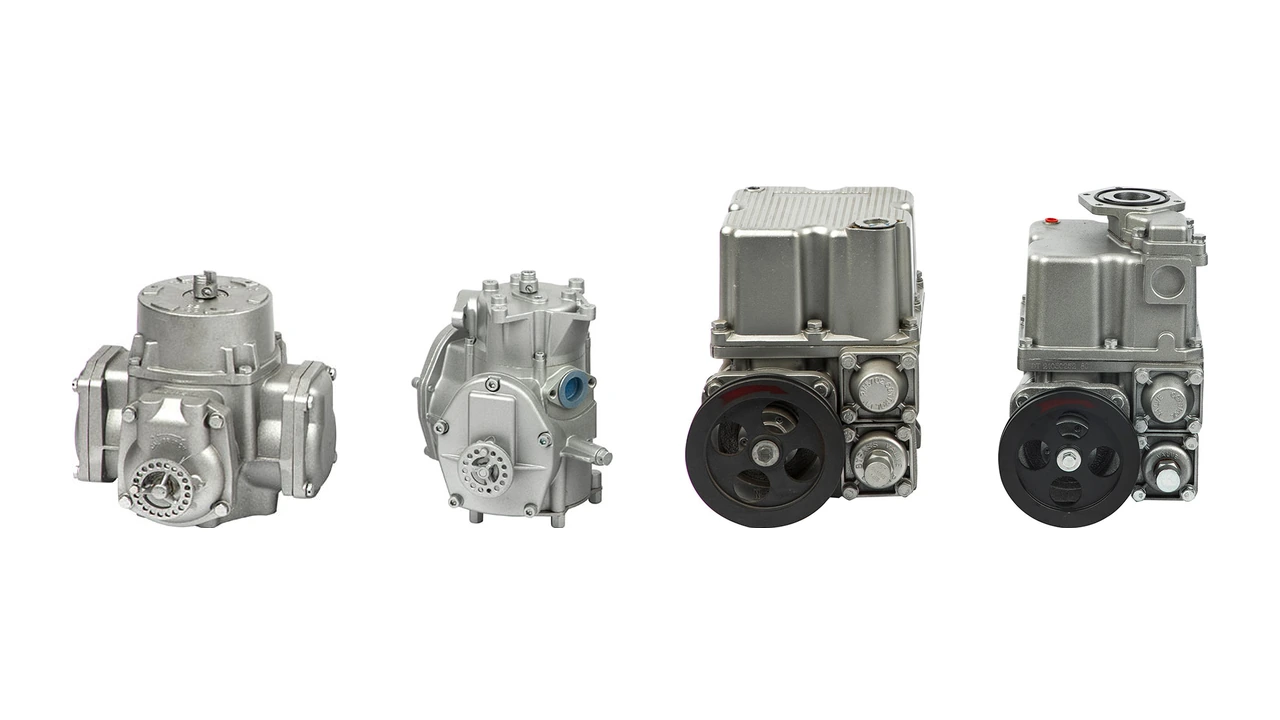
Seven component codes cover most of the replacement enquiries we get for Tatsuno and Bennett dispensers. This is the cross-reference: what each code is, the flow and drive it is rated for, which family it belongs to, and the two or three numbers that decide whether it drops in.
Read the nameplate before the brand
A dispenser brand tells you who assembled the cabinet, not who made the hydraulic set inside it. The same cabinet sold into three markets can carry three different pump and meter combinations, and the parts inside are rarely marked with the dispenser name. What decides fit is narrower than a brand: the mounting footprint, the displacement per revolution or the flow at drive speed, the shaft rotation, and the port or flange size.
This list exists because that is the part of the trade we know from the inside. Datian components have gone into dispensers built under the Gilbarco, Tokheim, Tatsuno and Bennett names, and the seven codes below are the ones we still build and quote today.
J4 (DTJ4): the meter on a Tatsuno-type hydraulic set
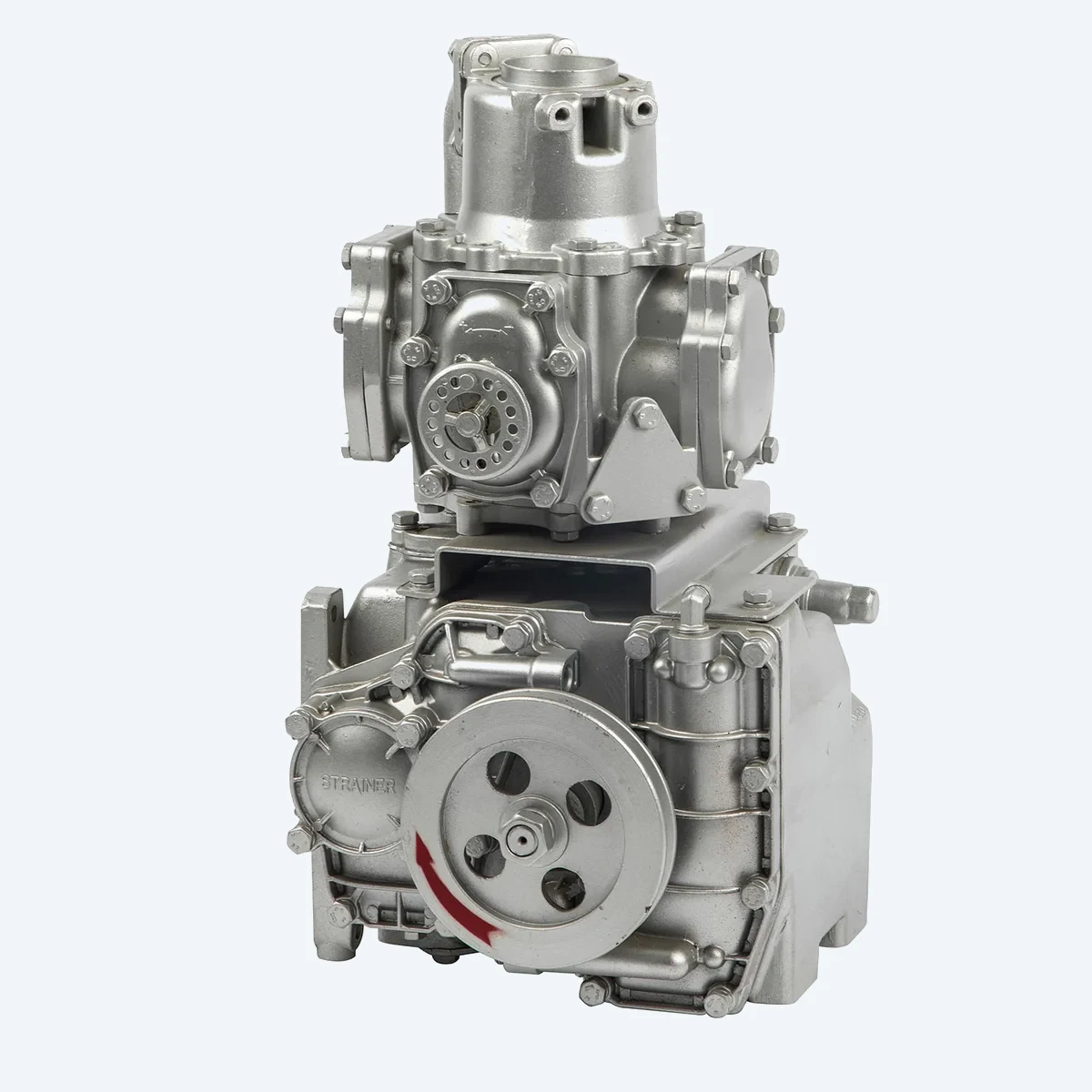
The DTJ4 discharges 0.5 litres per revolution across a 5 to 100 L/min range at ±0.2%, with repeat error at or below 0.1% and working pressure of 0.12 to 0.35 MPa, turning clockwise. Rated working life is 10,000,000 litres. The body measures 234 mm level and 225.4 mm vertical, and that is the envelope the mounting has to accept.
Three variants share that body: DTJ4A, DTJ4B and DTJ4C differ in inlet configuration, not in metering. Read the letter on the plate before ordering, because on a photograph the letter is the only thing that separates them.
The J4 is the meter that goes with the CP5 pump, and that is the pairing the flow meter range lists as Tatsuno type — standard mounting dimensions that suit a Tatsuno cabinet as well as a Gilbarco, Tokheim or Bennett one. Full figures are on the DTJ4 page, and the range itself is on flow meters.
J6 (DTJ6): the same meter at twice the displacement
The DTJ6 is 1 litre per revolution over 5 to 160 L/min at ±0.2%, same working pressure of 0.12 to 0.35 MPa and the same clockwise rotation, in a body of 256 mm level and 254 mm vertical. It exists for one reason: above roughly 100 L/min the half-litre meter has to spin faster than the dispenser's hydraulics want to drive it, so the displacement is doubled instead of the speed.
That makes the J6 a high-flow part, normally paired with the CP8 pump below. It is a direct component or a replacement meter on a high-flow cabinet — see the DTJ6 page for the mounting drawing.
CP5: the variable-speed gear pump
The CP5 is a gear combination pump of the Tatsuno type, with the pump and the air separator in one casting. A 0.75 kW motor drives it across a 680 to 980 rpm band and the rated flow follows the speed, from 45 to 90 L/min. Dry vacuum is 0.054 MPa or better, noise stays at or below 72 dB and output pressure runs 0.18 to 0.3 MPa. That is the duty a Tatsuno-type installation is specified for, so this is the pump we quote when such a hydraulic set has lost its own.
Because it is a positive-displacement pump, the body does not decide the flow — the drive does. The pulley or coupling ratio on the dispenser sets what you will actually see at the nozzle, which is why we ask for it before quoting rather than after. Figures and the spares list are on the CP5 page.
CP8: the 140 L/min vane pump
The CP8 is a vane combination pump rated 140 L/min on a 1.1 kW motor at 660 rpm, output pressure 0.18 to 0.35 MPa, dry vacuum 0.054 MPa or better and noise at or below 74 dB. It uses roller bearings for a long service life, and a generously sized separation chamber, so the oil and gas are separated completely before delivery.
Fixed speed, fixed displacement, one flow rating: that is the whole difference from the CP5. It pairs with the J6 meter, and the two are specified together — a 140 L/min pump behind a 100 L/min meter is a mismatch the customer discovers at the nozzle, not on the drawing. See the CP8 page.
JBL50, JBL80 and J100: the Bennett side
These three are the Bennett-side codes, and the two pumps are the pair that gets confused most often. The JBL50 is a vane combination pump rated 60 L/min, and the JBL80 is its 80 L/min development. Both run a 0.75 kW motor at 660 rpm, both sit in an aluminium alloy shell, both give 0.054 MPa of dry vacuum or better, 72 dB or less and 0.18 to 0.35 MPa of output pressure. The only difference that matters is the rated flow, and the two are not interchangeable as replacement units.
The DTJ100, written J100 on dispenser documentation, is the meter on the same side: 0.5 litres per revolution, 5 to 100 L/min, ±0.2%, 0.12 to 0.35 MPa, clockwise. On paper it is identical to the J4, and that is the trap — the body is 224 mm level and 197 mm vertical against the J4's 234 mm and 225.4 mm, so the two do not swap onto the same mounting. Details are on the DTJ100 page, with the pumps on JBL50 and JBL80.
Why we can speak to this side at all: Bennett Pump set up a joint venture in Shanghai in 2001 to build pumps, positive-displacement meters, valves and dispensers for the Asian market, and Datian held 49% of it. Hines Corporation, Bennett's parent, bought our share in 2007–2008, so that company is wholly Bennett's today. We hold no equity in it, we are not a Bennett subsidiary, and we are not authorised or endorsed by Bennett Pump Company. What the joint-venture years left behind is the drawings and the habit of building a component to somebody else's specification — which is exactly what a replacement part has to do. The fuller record, with dates and sources, is in Bennett replacement parts.
Cross-reference
| Code | What it is | Rated flow | Drive | Check before ordering |
|---|---|---|---|---|
| DTJ4 / J4 | Flow meter | 5–100 L/min, 0.5 L/rev | — | Inlet variant A, B or C; 234 × 225.4 mm body |
| DTJ6 / J6 | Flow meter | 5–160 L/min, 1 L/rev | — | High-flow cabinet; 256 × 254 mm body |
| DTJ100 / J100 | Flow meter | 5–100 L/min, 0.5 L/rev | — | 224 × 197 mm body — not a J4 |
| CP5 | Gear combined pump | 45–90 L/min | 0.75 kW, 680–980 rpm | Pulley or coupling ratio |
| CP8 | Vane combined pump | 140 L/min | 1.1 kW, 660 rpm | Motor rating and inlet pipework |
| JBL50 | Vane combined pump | 60 L/min | 0.75 kW, 660 rpm | Not an 80 L/min unit |
| JBL80 | Vane combined pump | 80 L/min | 0.75 kW, 660 rpm | Not a 50 L/min unit |
Pairs that get ordered wrong
Four mistakes account for most of the returns, and none of them is visible from a photograph:
- J4 against J6. 0.5 against 1 litre per revolution. Fit the small meter behind a high-flow pump and you are running it past its 100 L/min rating; fit the large one on a standard cabinet and the pulse count no longer matches the volume, so the dispenser reads wrong while working perfectly.
- CP5 against CP8. A variable-speed gear pump against a fixed 140 L/min vane pump. They are not two versions of one part, and the pipework and mountings differ.
- JBL50 against JBL80. 60 against 80 L/min on the same 0.75 kW drive, in the same housing family. Same motor, different delivery — the nameplate is the only place the difference is written.
- J4 against J100. Identical displacement, identical flow range, identical accuracy, different body height. The one pair that looks interchangeable on paper and is not.
The same guide as a poster
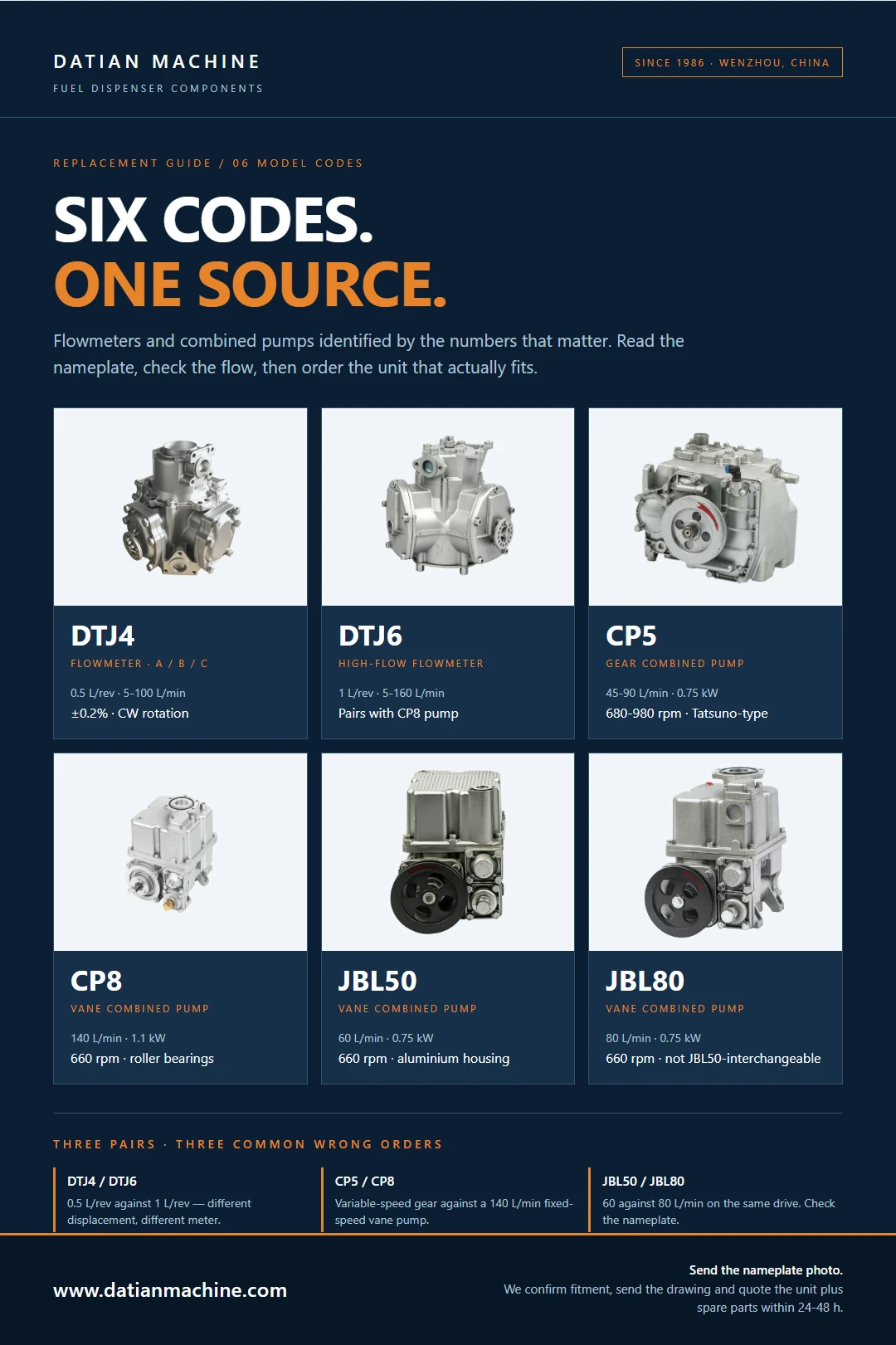
If it is easier to keep at the counter than on a screen, the six hardware codes as a one-page poster:
What to send with the enquiry
Four things get a quotation out within 24 to 48 hours: the code on the unit you are taking out, or a photograph of the nameplate; the flow you need at the nozzle; the drive details, meaning motor rating and pulley or coupling ratio for anything gear-driven; and the voltage for anything electrical. Fitment is confirmed against the drawing before the order is accepted, not after the box arrives.
Datian builds these seven codes in Wenzhou and supplies them direct — complete units, and the wear parts for an overhaul: gears and seals for the CP5, vanes and roller bearings for the CP8, meter bodies and inlet configurations for the DTJ range. Request a quotation and tell us which code you are holding.
Common questions
Yes. DTJ4 is the catalogue code, J4 is the same meter as written on dispenser documentation and used in the trade, and DT-J4 is the hyphenated form. All three name one body, made in three variants: DTJ4A, DTJ4B and DTJ4C, which differ in inlet configuration rather than in metering.
Because it is a positive-displacement gear pump, so the flow follows the drive speed across a 680 to 980 rpm band. The same pump body delivers a different flow at a different pulley ratio, which is why the ratio is checked before a replacement is quoted rather than assumed from the code.
No. Both run a 0.75 kW motor at 660 rpm in the same housing family, but the JBL50 is rated 60 L/min and the JBL80 is rated 80 L/min, and they are not interchangeable as replacement units. Read the nameplate on the pump you are removing before ordering either.
Tatsuno and Bennett are trademarks of their respective owners. Zhejiang Datian Machine Co., Ltd. is not a subsidiary of either company and is not authorised or endorsed by them; the names appear here only to describe the equipment these parts are bought to fit.