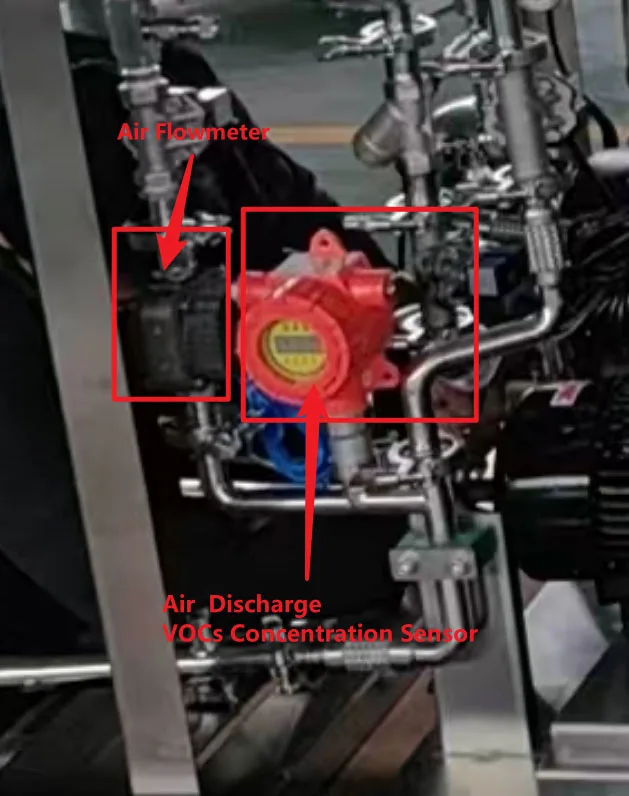
Difference 1: Quantification is Key. We not only measure but also boldly disclose the exact VOCs concentration in our exhaust.
While traditional Vapor Recovery Units (VRUs) focus on basic condensation, Green Guard represents the next evolution: a closed-loop system that truly captures, contains, and quantifies vapor recovery. Let’s break down the fundamental differences:
1. Core Process: From Basic to Precision
- Traditional VRU: Relies on condensation; residual, un-liquefied vapors are often simply released.
- Green Guard VRU: Employs condensation plus advanced Membrane Separation. This technology precisely isolates hydrocarbon molecules from air, ensuring only clean components proceed.
2. Emission Path: From Single Outlet to Intelligent Dual Path
- Traditional VRU: Features a single outlet. Treated vapor is typically discharged directly into the atmosphere.
- Green Guard VRU: Utilizes a dual-outlet system. The Un-liquefied vapor is redirected back into the Underground Storage Tank (UST), while only verified clean air is released.
3. Emission Monitoring: From Assumption to Assurance
- Traditional VRU: Rarely equipped with continuous, verifiable emission monitoring.
- Green Guard VRU: Integrates a VOCs concentration detector and gas flow meter at the exhaust point, providing real-time, quantifiable data for complete transparency.
Why We Built It This Way
Traditional designs can allow hydrocarbons to escape. Green Guard’s integrated vapor separation pipeline and membrane stage ensure that:
- Un-liquefied gasoline vapor is re-injected into the UST.
- Only clean air is released to the atmosphere.
This directly addresses the industry’s common limitation: the lack of monitored and published tailpipe emission data.
What Green Guard Delivers: Tangible Results
Our quantified approach delivers two powerful, verifiable outcomes:
True Vapor Containment: Eliminates product loss, locking in value for gas stations by making vapor recovery measurable and quantifiable.
Verifiable Environmental Protection: Provides tangible data to meet and prove environmental compliance, demonstrating minimized emissions.
This innovation offers precise UST pressure control and delivers on the true promise of environmental stewardship.
Stay tuned as we dive deeper into the next critical differences:
- Difference 2: Is the condensed liquid really “saved” oil?
- Difference 3: The real efficiency challenge of traditional VRUs.
- Difference 4: How Green Guard provides targeted solutions for different stations.
- Difference 5:
#VaporRecovery
#VRU
#Sustainability
#CleanTech
#OilAndGas
#EnvironmentalCompliance
#Innovation
#greenguard
#datian