
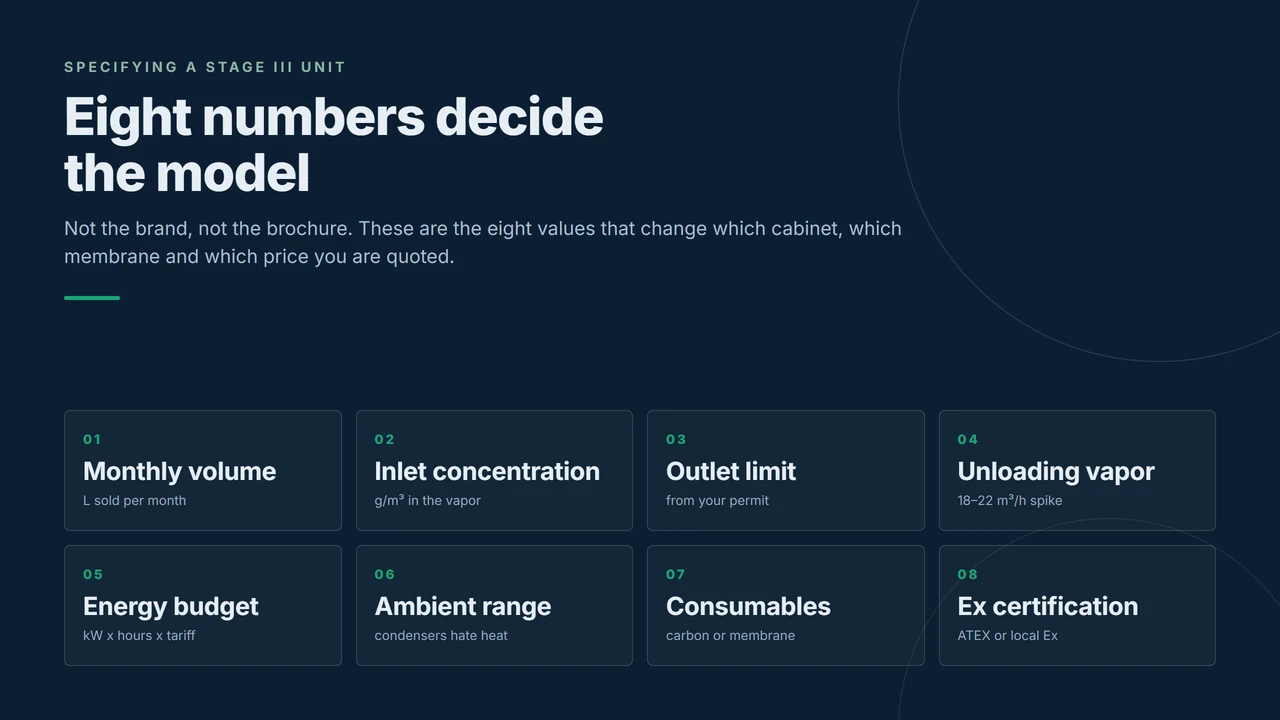
A vapor recovery unit is specified by eight numbers, and only two of them usually change which model gets quoted. This is the list, in the order we ask for it, with the values that move a station from one cabinet to another.
1. Monthly throughput, not annual tonnage
Start from litres sold per month, because that is the number the station already knows. Each litre leaving the dispenser displaces roughly its own volume of saturated vapor from the tank, so 1,000,000 L a month is about 1,000 to 1,200 m³ of vapor a month, or 33 to 40 m³ a day. Divide that by the hours the unit actually runs and the processing capacity follows: at 5 to 8 running hours a day, 1,000,000 L a month needs 4 to 8 m³/h. Below that volume the DT-100M covers the range on its own; at and above it the DT-VR26M1 and M2 are the models, running to 12 m³/h.
Tank count matters as much as volume, because each tank breathes on its own cycle: four tanks at the same monthly throughput give a different peak from two.
2. Inlet concentration
In the field the inlet runs 700 to 1,500 g/m³, depending on product volatility and on the temperature of the fuel in the tank. It matters because every architecture's efficiency is quoted at a concentration, and condensation in particular loses both recovery and outlet margin when the inlet is lean. The unit we tested was fed 700 g/m³, the bottom of that range; if your product is lighter or your tanks run hot, say so, because it changes the sizing rather than just the prediction.
3. The outlet limit in your permit
Not the number in a brochure, and not a number we choose. The permit states a concentration at the vent and a method for proving it, and the unit has to hold that figure with a margin through the worst hour of the year rather than on a mild morning. Bring the permit clause to the quotation. Where the required figure is tight, it is the membrane stage that carries it, and the number of membrane stages becomes a specification rather than a detail.
4. What happens during tanker unloading
This is the number that changes the model most often, and it is the one most often left out of an enquiry. A tanker discharge pushes 18 to 22 m³/h of vapor for the length of the delivery, against a processing capacity of 6 to 12 m³/h. Three outcomes are possible: the unit absorbs it, the vapor is routed back to the truck through Stage I, or the site buys the version with Stage I assist. On our range that is the difference between the DT-VR26M1 and the DT-VR26M2, and it is a specification decision, not an upgrade.
5. The energy budget, in kWh rather than per cubic metre
Price energy the way the meter does: rated power multiplied by hours run. The DT-VR26M2 draws 7 kW. In China these units run 5 to 8 hours a day, so 7 kW is 35 to 56 kWh a day, or 12,800 to 20,400 kWh a year. At an industrial tariff around 0.7 CNY per kWh that is 9,000 to 14,300 CNY a year for the whole unit, with no conversion to cubic metres in the middle.
Set that against the fuel. A station at 1,000,000 L a month displaces about 1,000 m³ of vapor a month, which at 0.7 kg of hydrocarbon per cubic metre is roughly 700 kg, or 950 litres of petrol. Over a year that is around 11,000 litres, worth about 80,000 CNY at 7 CNY a litre, so a unit recovering most of it makes the electricity a tenth to a sixth of the fuel value. That ratio is the reason to buy a unit at all; it is not the reason to choose between architectures.
What does distinguish the architectures is duty cycle: how many hours a day the machine actually runs. A 7 kW unit at 5 hours a day is 35 kWh; a 3.5 kW unit left running around the clock is 84 kWh. Ask for running hours, not for a per-cubic-metre figure that changes with how busy the station is.
6. Ambient temperature range
A condenser rejects heat into the surrounding air, so a site at 45 °C ambient and a site at 10 °C ambient cannot use the same cold stage with the same margin. Our units are rated for −20 to +50 °C, and the hybrid architecture's condenser works below −20 °C rather than at −45 °C, which is what keeps that rating honest in a hot country. If the station is in a cold climate, the reverse applies and a deep-cold architecture becomes viable where it would not be in the Gulf.
7. What has to be replaced, and by whom
Every architecture has a consumable except condensation only. Carbon is replaced at three months, or sooner if the bed saturates, which in practice means somewhere between one and three months, and the spent media is a hazardous waste that needs a licensed route. A membrane module is replaced every three to eight years and is a part, not a waste. Ask for the interval, the part price, the lead time to your country, and whether the replacement is a site task or a service visit. Then price five years of it into the comparison, because that is where a cheap quotation stops being cheap.
8. Ex certification for the zone you actually have
A vapor recovery unit sits at the vent of a tank that contains gasoline, which puts it in a potentially explosive atmosphere by definition. What matters is the zone, the gas group and the temperature class, and whether the certificate on offer matches the scheme your authority recognises. Green Guard carries EU-type examination certificate IEP 26 ATEX 1835X, marked II 1/2G Ex h IIB T4 Ga/Gb for the mechanical assembly and II 2G Ex db mb sb IIB T4 Gb for the electrical parts, with the host enclosure at IP55 and cable entries at IP65. If your market runs its own Ex scheme rather than ATEX, ask for the equivalent document before the unit ships, not after.
The eight, as a form to fill in
| # | Value | Typical answer | What it changes |
|---|---|---|---|
| 1 | Monthly throughput | 4–8 m³/h below 1,000,000 L a month, 8–12 m³/h at and above | Cabinet size and membrane area |
| 2 | Inlet concentration | 700–1,500 g/m³ depending on product and tank temperature | Predicted outlet and recovery |
| 3 | Outlet limit | The figure written in the permit | Number of separation stages |
| 4 | Unloading vapor | 18–22 m³/h for the length of a delivery | Stage I assist, or not |
| 5 | Energy | 7 kW, 5–8 running hours a day | Annual kWh and the bill |
| 6 | Ambient range | −20 to +50 °C on our range | Which architecture is viable |
| 7 | Consumables | Membrane 3–8 yr, carbon 1–3 months | Five-year cost |
| 8 | Ex certification | ATEX, or the local Ex scheme | Whether the unit can be installed at all |
Retrofit, and the three things that are not on the datasheet
Most Stage III work is a retrofit onto a station that already has Stage I and Stage II. That changes the enquiry: the unit is the easy part, and the installation is where projects slip. Three items decide it. The foundation: ours needs a reinforced concrete platform of at least 1,700 × 1,200 × 200 mm, with the baseplate 200 to 300 mm above finished grade. The power: a 3.5 to 7 kW load at 220, 380 or 415 VAC, 50 or 60 Hz, on a cable sized for the run rather than the unit. And the vent line route, which on a tight forecourt decides where the cabinet can physically go before anything else is discussed. Those three are usual, and they are the reason a quotation that omits them is not comparable with one that includes them.
What we would send back
Give us the eight values and we will answer with a model, a flow diagram, the certificate and the five-year consumable cost. Where the eight values point at a different architecture than the one we build, we will say that as well. The models are on the Green Guard page, the installation history is in the gallery, and the architecture comparison behind the choices is in condensation, membrane or hybrid.
Common questions
Estimate it from monthly volume and tank count first, then confirm it. A station at 1,000,000 L a month needs 4 to 8 m³/h at 5 to 8 running hours a day, and above that volume the figure moves into the 8 to 12 m³/h band. The peak also depends on how many tanks breathe and how fast a delivery is unloaded. If you have a tank pressure log, that is better than any estimate, because it shows how quickly pressure recovers after a delivery.
That is what Stage I does on a site without Stage III, and it is compliant where the rules allow it. What it costs is the fuel in the peak, and the peak is the densest vapor the site produces. Sizing for the average and routing the excess back to the truck is a legitimate choice for a small site; it should be a choice, though, made with the recovered volume priced out, rather than something discovered after commissioning.
A reinforced concrete platform of at least 1,700 by 1,200 by 200 mm with the baseplate standing 200 to 300 mm above finished grade, a supply sized for 3.5 to 7 kW depending on model at the local voltage and frequency, and a vent line route from the tank to the cabinet. Add an earth connection and, for the cloud-connected models, a data path. Everything else arrives with the unit.