
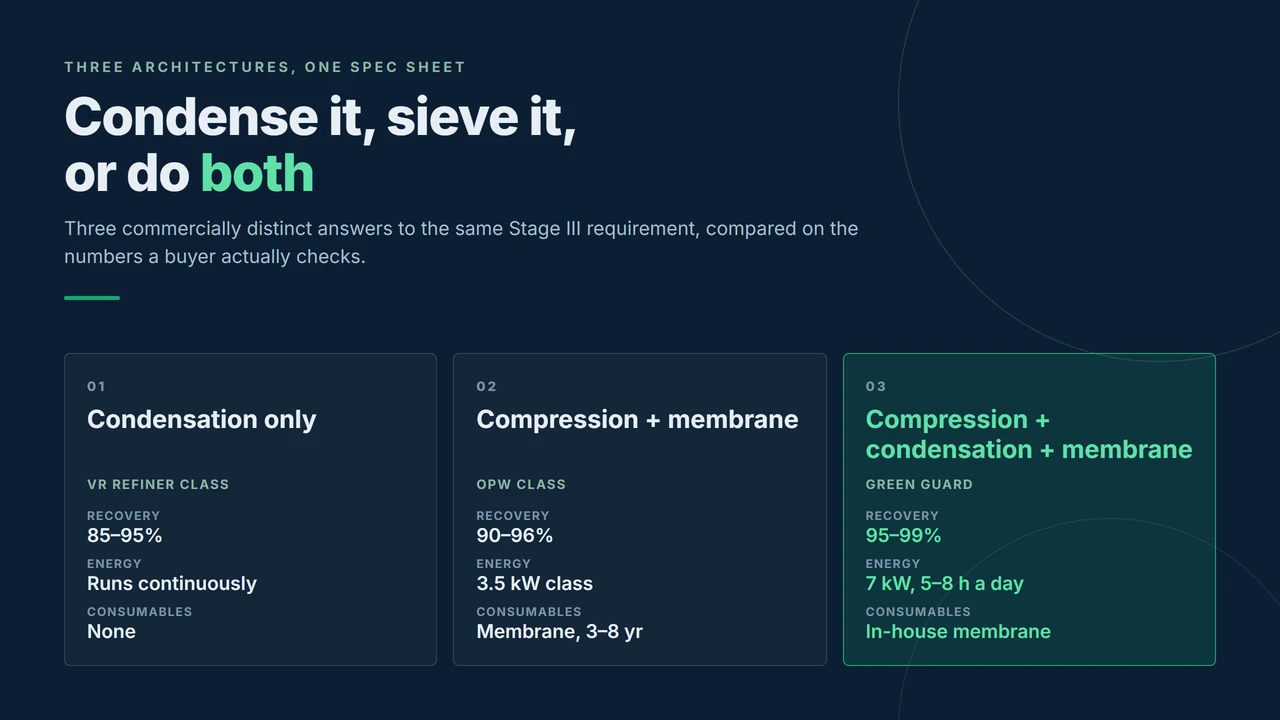
Strip the market down to what a station actually installs and three architectures remain: condense the fuel out of the air, pressurise it and sieve it through a membrane, or do both in one cabinet. Each has a commercial reference. This is the comparison on the numbers a buyer checks, with the assumptions behind each figure stated where it matters.
Two notes before the table. The figures for the condensation-only and membrane-only architectures are typical values for the class, taken from published material and from our own field notes on units we have surveyed; check them against the datasheet for the exact model you are quoted, because a single stage and a three-stage machine differ by more than the badge. And every efficiency figure below is a vendor figure until a third-party test report is attached to it, ours included.
The three, in one sentence each
- Condensation only (VR Refiner is the reference here): refrigeration does all the separation, there is no compressor in the vapor path and no consumable to replace, and the refrigeration runs continuously to stay ready.
- Compression plus membrane (OPW is the reference, with membrane units in service since 2002): a compressor and an air cooler take out part of the fuel, a polymer membrane separates the rest, and the unit waits on standby between events.
- Compression, condensation and membrane (Green Guard is our own): a compressor, a condenser at a medium-low temperature, below −20 °C, and a membrane in series, two liquid return paths, standby start.
The comparison
| Criterion | Condensation only | Compression + membrane | Compression + condensation + membrane |
|---|---|---|---|
| Recovery, single pass | 85–95% | 90–96% | 95–99% claimed |
| Recovery, staged | 98%+ at three stages | 97%+ at two membrane stages | Two stages in series as standard |
| Outlet concentration | Struggles at low inlet load | Depends on membrane condition | Measured below 5.1 g/m³ at 700 g/m³ inlet |
| Energy | Continuous refrigeration | 3.5 kW class, standby | 7 kW, 5–8 hours a day |
| Liquid recovered | High | Moderate; best in cool climates | High, two return paths |
| Tanker unloading | Handles it | Left to Stage I | Handles it with Stage I assist, 18–22 m³/h |
| Consumables | None; condenser box ages | Membrane, 3–8 years | Membrane, made in house |
| Ambient sensitivity | High; needs cold to work well | Moderate; hot air costs margin | Rated −20 to +50 °C |
| Complexity | One subsystem | Two | Three |
| Capital cost | Mid | Low to mid | Highest |
| Certification on offer | ATEX | ATEX or local Ex scheme | ATEX, IEP 26 ATEX 1835X |
Efficiency: the number that is least comparable
Read the first two rows together and the honest answer is that all three can hold a regulatory limit, and the difference shows up in what it costs to hold it. Condensation only needs a third stage to reach 98%, and the third stage is the expensive one. A membrane unit needs a second stage in series to reach 97%, which means two modules instead of one. The hybrid starts with both mechanisms and reaches its number without adding a stage.
What can be measured rather than claimed is the outlet concentration. Ours was measured on a Green Guard unit fed 700 g/m³ of gasoline vapor: at every flow rate from 3.5 to 4.5 m³/h the tail gas stayed below 5.1 g/m³. That test is published with its figures in the membrane emission test, including the readings that were less flattering.
Energy: price it in kWh, not in cubic metres
These are single-figure loads: the Green Guard hybrid draws 7 kW, and a membrane-only unit of similar capacity 3.5 kW. The bill is power multiplied by hours, so what separates the architectures is how long each one has to run rather than a per-cubic-metre rating. In China ours run 5 to 8 hours a day, which puts a 7 kW unit at 12,800 to 20,400 kWh a year, or 9,000 to 14,300 CNY at an industrial tariff.
A condensation-only unit cannot stand still the way a membrane or hybrid unit can, because its cold surface has to stay cold before the vapor arrives. Longer hours are what it costs, and a figure quoted per cubic metre does not show them. Set the whole bill against the fuel and it is a fraction of it: a station at 1,000,000 L a month displaces around 1,000 m³ of vapor a month, about 700 kg of hydrocarbon, so a year of recovery is worth far more than the electricity. Energy is worth asking about; at station scale it is rarely the number that decides.
The unloading hour
This is the criterion that separates the three most cleanly, and it is usually missing from the datasheet. When a tanker discharges, the tank it is filling pushes out vapor at 18 to 22 m³/h, for about as long as the delivery takes. Three responses exist. A condensing unit can absorb the load, because its cold surface has the capacity and it is already running. A membrane unit generally cannot, so the vapor goes back to the truck through Stage I, which is compliant and recovers nothing. The hybrid can, if it is built with Stage I assist, which is what the DT-VR26M2 does.
Ask the question directly when you are quoted: at what flow does the unit keep recovering during unloading, and what happens above it. An answer that describes the average flow rather than the peak is not an answer.
Consumables and the service visit
Condensation only has the cleanest story here and we will not pretend otherwise: no bed, no module, nothing to replace on a schedule. The wear item is the condenser box itself, which corrodes over a service life and eventually needs replacing as a unit rather than as a part.
A membrane unit replaces modules every three to eight years, and that is a planned cost of 6 to 12% of capex a year including the visit. The hybrid has the same membrane obligation, with one difference: we make the membrane ourselves, and the units in service have passed four years on the original modules. That is a supply argument, not a reliability argument, and it is worth exactly what local stock and a lead time are worth to you.
Climate
Condensation only is at its best where the ambient is cold and at its worst in the Gulf, because the condenser has to reject heat into air that is already at 45 °C. The membrane architecture loses margin in heat as well, through the air cooler rather than the condenser. The hybrid sits in between: a condenser held below −20 °C is far less exposed than one at −45 °C, and the units are rated for −20 to +50 °C ambient. If you are specifying for a hot site, the deep-cold architecture is the one to think hardest about.
Three questions that settle it
Ask any supplier these three, in this order, and the architecture will pick itself. Does the unit recover during tanker unloading, and at what flow. What is the outlet concentration measured by a third party, at the inlet concentration my station actually sees. And what has to be replaced, by whom, on what interval, at what cost.
The models behind the third column, with the certificate and the drawings, are on the Green Guard page. If you are earlier in the process and still choosing between architectures rather than brands, start with the five technology paths, then use the eight numbers to size what you need.
Common questions
It depends on two things, and neither is the efficiency figure. If the station takes tanker deliveries and wants the unloading vapor recovered rather than returned to the truck, the hybrid is the only one of the three that does it without a separate Stage I assist arrangement. If the outlet limit has to hold through a hot afternoon at low inlet concentration, two separation stages leave more margin than one. Where neither applies, a membrane-only unit is the better buy and we will say so.
Three to five years is the normal planning figure for a polymer module in this service, and replacement is a scheduled cost rather than a repair. Green Guard uses a membrane we make in house, and the units in the field have passed four years on their original modules. The honest qualification is that membrane life follows inlet quality: a unit with a working coalescing filter in front of it will outlast one without.
Yes, and that is the usual retrofit. Stage I and Stage II handle the tanker connection and the dispenser nozzle respectively; Stage III is the vapor processor at the vent, and it is added downstream of both. What the retrofit needs is a foundation, a power supply and a place to route the vent line, which is why the platform dimensions and the electrical schedule matter more than the cabinet size on a tight site. The Stage II side of that work is covered in the Stage II retrofit parts page.